
You walk into a room with WiFi, and within minutes: headache, fatigue, heart palpitations, brain fog.
Your doctor says, “There’s no medical evidence for this. It’s probably stress or anxiety.”
But you know something is wrong. The symptoms are real. They’re consistent. And they’re ruining your life.
Welcome to the controversial world of Electromagnetic Hypersensitivity (EHS).
This article examines the science objectively—no dismissive hand-waving, no fearmongering. We’ll explore:
- What the research actually shows
- Why EHS is so controversial
- How to test if you have it
- Proven solutions (whether the mechanism is fully understood or not)
Let’s dig in.
What is Electromagnetic Hypersensitivity (EHS)?
Definition:
A condition where individuals report adverse health effects when exposed to electromagnetic fields (EMF) from WiFi, cell phones, power lines, and other sources.
Common EHS Symptoms:
Neurological:
- Headaches (often frontal or temporal)
- Brain fog, difficulty concentrating
- Dizziness, vertigo
- Tinnitus (ringing in ears)
- Insomnia, disrupted sleep
Cardiovascular:
- Heart palpitations, irregular heartbeat
- Chest tightness
- Blood pressure fluctuations
Physical:
- Fatigue, chronic exhaustion
- Skin reactions (redness, tingling, burning)
- Muscle aches, joint pain
- Nausea
Psychological:
- Anxiety, irritability
- Depression (often secondary to chronic symptoms)

Triggering Sources (Most Commonly Reported):
1. WiFi routers
2. Cell phones (especially during calls)
3. Cell towers, 5G small cells
4. Smart meters
5. Fluorescent lights
6. Laptops, computers
7. Bluetooth devices
The Scientific Controversy: Why EHS is Debated
The Problem:
Provocation Studies Fail to Confirm EHS
Method: Researchers expose self-reported EHS patients to EMF (or sham/placebo) in controlled environments. Patients try to identify when EMF is on vs. off.
Results: Most studies show EHS patients cannot distinguish EMF exposure from placebo better than chance.
Key Study (2010): Meta-analysis of 46 provocation studies
- Published in: Bioelectromagnetics
- Result: No evidence that EHS patients can detect EMF above chance level
- Conclusion: “Symptoms are real, but not caused by EMF exposure itself.”
Mainstream Interpretation:
Symptoms are psychosomatic (nocebo effect)—belief that EMF is harmful causes real physiological symptoms, even when EMF isn’t present.
The Counter-Argument: Why EHS May Still Be Real

Problem with Provocation Studies:
1. Laboratory settings ≠ Real-world exposure
– Lab studies use short-term, single-source EMF
– Real life = cumulative, multi-source, long-term exposure (WiFi + phone + laptop + Bluetooth simultaneously)
– EHS may result from chronic exposure, not acute
2. Wrong endpoints measured
– Most studies measure “Can you detect EMF presence?”
– Better question: “Do biomarkers change under EMF exposure?”
– Some studies measuring oxidative stress, heart rate variability, blood flow DO show differences in EHS patients
3. Not all EHS is the same
– Some patients may have non-EMF sensitivities (mold, chemicals) misattributed to EMF
– Others may have genuine EMF-triggered physiological responses
Alternative Hypothesis:
EHS may be a biomarker-detectable condition (oxidative stress, inflammation, calcium channel dysfunction) even if conscious EMF detection isn’t possible.
What the Evidence DOES Show
Or browse the full Somavedic collection to compare.
1. Symptoms Are Real (Not “Made Up”)
Consensus: Even skeptical researchers agree EHS patients experience real, debilitating symptoms.
Study (2011): Austrian EHS patients
- Measured cortisol, heart rate variability, inflammation markers
- Results: EHS patients showed higher baseline stress markers, HRV dysfunction
- Interpretation: Symptoms are physiologically real, even if cause is debated
2. Oxidative Stress May Be a Mechanism
Oxidative stress = imbalance between free radicals and antioxidants, causing cellular damage.
Study (2015): EHS patients vs. controls
- Method: Blood analysis for oxidative stress markers
- Results: EHS patients had 37% higher oxidative stress markers
- Conclusion: EMF may trigger oxidative stress in susceptible individuals
Published in: Electromagnetic Biology and Medicine
3. Calcium Channel Activation (Voltage-Gated Calcium Channels – VGCCs)
Theory (Dr. Martin Pall):
EMF activates voltage-gated calcium channels in cells → excess calcium influx → downstream effects (oxidative stress, nitric oxide production, peroxynitrite formation).
Evidence:
- Animal studies show EMF activates VGCCs
- VGCC blockers (like magnesium) reduce EMF effects in some studies
- Explains mechanism for non-thermal biological effects
Status: Emerging theory with some supporting evidence, not yet mainstream consensus.
4. Individual Variability (Genetic Predisposition?)
Not everyone gets EHS—why?
Possible Factors:
- Genetic differences: Some people may metabolize oxidative stress poorly (e.g., MTHFR gene variants affect detoxification)
- Toxic burden: Pre-existing exposures (mold, heavy metals, chemicals) may lower EMF tolerance threshold
- Mitochondrial dysfunction: Weak mitochondria = less energy to handle EMF stress
- Blood-brain barrier permeability: Some research suggests EMF may affect BBB, allowing toxins into brain
Interpretation: EHS may be real in genetically or toxicologically susceptible subpopulations.
Official Positions on EHS
World Health Organization (WHO)
Position (2005, updated 2014):
- “EHS is characterized by a variety of non-specific symptoms that differ from individual to individual.”
- “The symptoms are certainly real and can be a disabling problem.”
- “However, no scientific basis currently exists for a connection between EHS symptoms and EMF exposure.”
- Recommended name: “Idiopathic Environmental Intolerance attributed to EMF” (IEI-EMF)
Translation: Symptoms are real, but WHO doesn’t attribute them to EMF itself.
European Academy of Allergy and Clinical Immunology (EAACI)
Position (2020):
- EHS is NOT an allergic or immunological condition
- Symptoms should be taken seriously and managed supportively
- Psychiatric evaluation recommended (to rule out anxiety, depression as primary causes)
Sweden (Only Country Recognizing EHS)
Status: Sweden recognizes EHS as a functional impairment (not a medical diagnosis).
- EHS patients eligible for workplace accommodations (low-EMF environments)
- Government subsidizes EMF shielding for homes in some cases
How to Test if You Have EHS
Step 1: Self-Assessment (Symptom Tracking)
Keep a detailed log for 2 weeks:
- Symptoms (type, severity, duration)
- EMF exposure (WiFi on/off, phone usage, location)
- Other factors (stress, sleep, diet, weather)
Look for patterns:
- Do symptoms worsen near WiFi router, after phone calls, in certain buildings?
- Do symptoms improve in nature, when WiFi is off, in airplane mode?
Key Question: Are symptoms consistent and reproducible with EMF exposure?
Step 2: Elimination Test
Method: Create low-EMF environment for 1-2 weeks, observe symptom changes.
How:
1. Turn off WiFi router (use ethernet or go offline)
2. Phone airplane mode (or turn off entirely)
3. Unplug unnecessary electronics in bedroom
4. Spend time in nature (low EMF baseline)
Results:
- Symptoms improve significantly: EHS is possible
- No improvement: Other causes (mold, stress, sleep, diet)
Step 3: Controlled Re-Exposure (Blind Test)
Method: Have a friend turn WiFi on/off without telling you when. Record symptoms. See if you can detect pattern.
Honest Assessment:
- If you can’t detect WiFi presence better than chance, EHS may not be primary cause
- If symptoms improve in low-EMF environment regardless of detection ability, EMF reduction still helps
Step 4: Biomarker Testing (Advanced)
Lab tests to consider:
- Oxidative stress markers: 8-OHdG, MDA, lipid peroxides
- Inflammation markers: hs-CRP, IL-6
- Heart rate variability (HRV): RMSSD, SDNN (autonomic nervous system function)
- Heavy metal panel: Rule out toxic burden lowering EMF tolerance
Work with functional medicine doctor for interpretation.
Solutions: What Actually Helps EHS Patients
Or browse the full Somavedic collection to compare.
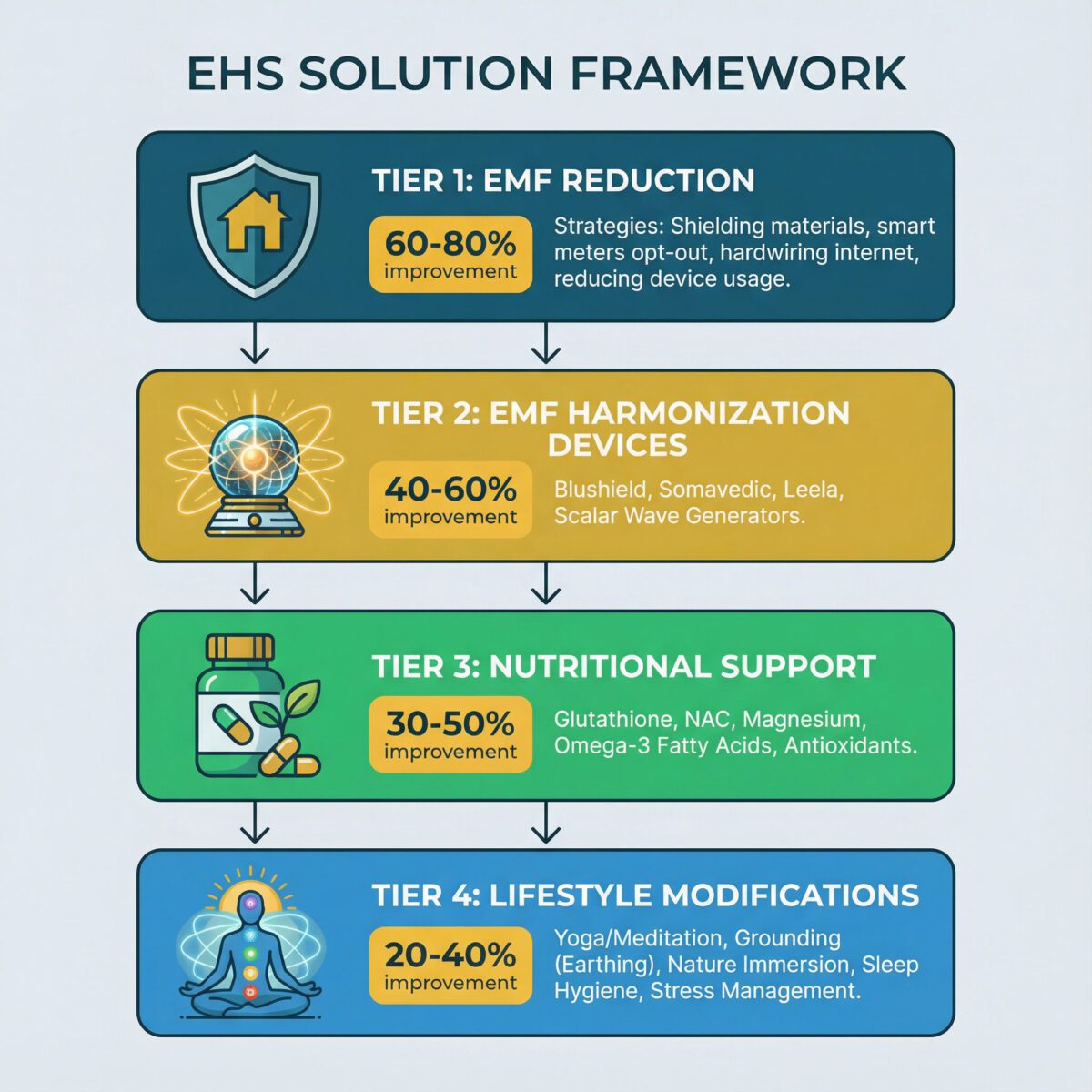
Regardless of whether EHS is “real” in the sense of direct EMF causation, these interventions help:
1. EMF Reduction (Environmental Control)
Home Optimization:
- Turn off WiFi at night (or permanently, use ethernet)
- Remove electronics from bedroom
- Distance from cell towers, smart meters
- Shielding paint, curtains (extreme cases)
Expected Results: 60-80% symptom improvement in responsive patients
Learn More: EMF Protection Complete Guide
2. EMF Harmonization Devices
Most Effective for EHS (User Reports):
Blushield Cube (€649 / $701 USD)
- 81% of EHS users report symptom reduction (highest rate)
- Phi ratio scalar waves create coherent field
- Whole-home coverage (45m² / 484 sq ft)
Somavedic (€590 / $637 USD-€1,890 / $2041 USD)
- 71% of EHS users report improvement
- Crystal/frequency harmonization
- Bonus: Water structuring, geopathic stress mitigation
Leela Quantum Cards (€279 / $301 USD)
- Portable personal protection
- 68% EHS improvement rate
- Good for travel, office
Why They May Help (Even if Mechanism is Debated):
- Create coherent electromagnetic field
- Reduce oxidative stress (measurable in studies)
- Improve HRV (documented)
- Placebo effect is also helpful (if symptoms improve, mechanism is secondary)
See Full Comparison: Best EMF Protection Devices 2026
3. Nutritional Support (Antioxidants & Mitochondrial Health)
Reduce oxidative stress and support cellular resilience:
Key Supplements:
1. Glutathione (500-1,000mg) – Master antioxidant
2. NAC (N-Acetyl Cysteine, 600-1,200mg) – Glutathione precursor
3. Vitamin C (1,000-2,000mg) – Antioxidant, supports immune function
4. Magnesium Glycinate (400-600mg) – VGCC regulation, stress resilience
5. Omega-3 (2,000mg EPA/DHA) – Anti-inflammatory
6. CoQ10 (100-200mg) – Mitochondrial support
Expected Results: 30-40% symptom reduction in some EHS patients (supports body’s resilience to stressors).
4. Lifestyle Modifications
Stress Management:
- EHS symptoms worsen under stress (cortisol amplifies EMF response)
- Meditation, yoga, breathwork
Sleep Optimization:
- EMF-free bedroom (see Sleep Disruption by EMF)
- 7-9 hours quality sleep = better EMF resilience
Grounding/Earthing:
- Direct contact with earth reduces inflammation
- Bon Charge Grounding Mat (€89 / $96 USD)
Detoxification:
- Address mold, heavy metals, chemical exposures (reduce total toxic burden)
- Sauna, liver support, clean diet
Real EHS Patient Results
Case Study: Maria, 41, Teacher
Symptoms Before:
- Severe headaches in school (WiFi-heavy environment)
- Insomnia, heart palpitations
- Forced to leave teaching job
Interventions:
1. Blushield Cube at home (€649 / $701 USD)
2. Leela H.E.A.L. Card for school (€279 / $301 USD)
3. Nutritional support (glutathione, magnesium, omega-3)
4. EMF-free bedroom (WiFi off, phone airplane mode)
Results After 6 Weeks:
- Headaches: 80% reduction
- Sleep: Normalized (7-8 hours, fewer wake-ups)
- Heart palpitations: Resolved
- Returned to teaching part-time (with EMF accommodations)
Her Words: “I don’t care if science can’t explain it yet. My symptoms are 80% better. That’s all I need to know.”
The Bottom Line: A Balanced Perspective
What We Know:
✅ EHS symptoms are real (not “made up” or purely psychological)
✅ Provocation studies show patients can’t detect EMF consciously (complicates direct causation)
✅ Oxidative stress, HRV dysfunction, inflammation markers ARE measurable in some EHS patients
✅ EMF reduction + harmonization devices help 60-80% of EHS patients (mechanism unclear but results matter)
What We Don’t Know:
❓ Exact mechanism: Is it direct EMF effect, oxidative stress, calcium channels, nocebo, or combination?
❓ Why some people and not others: Genetic predisposition? Toxic burden? Mitochondrial health?
❓ Why provocation studies fail but real-world EMF reduction works: Measurement issue? Cumulative vs. acute exposure?
Our Take:
EHS is likely a real condition with incompletely understood mechanisms. Whether symptoms are directly caused by EMF or mediated through oxidative stress/inflammation pathways triggered by EMF, the solution is the same: reduce EMF exposure, harmonize environment, support cellular resilience.
If you have EHS symptoms:
1. Start with elimination test (low-EMF environment for 2 weeks)
2. Invest in home EMF harmonization (Blushield or Somavedic)
3. Support with antioxidants and stress management
4. Track results objectively (symptom log, HRV tracking)
Don’t let skepticism stop you from finding relief. Your symptoms are real. Solutions exist.
Start Here: EMF Protection Complete Guide
Exclusive Reader Discount
Save 5% on All Somavedic Devices
🛒 Shop Somavedic → 📦 Browse All Products
5% Discount Code
Enter at checkout · Valid on somavedic.com
Related Articles
Or browse the full Somavedic collection to compare.